Customer programs with the situation, what RELY was responsible for, the controls and the results, plus one-page resources for plant, quality and purchasing leaders.
Showing 16 of 16 case studies
No. 20
Assembly · Water heater manufacturer
A manufacturer tripling sales moved subassembly off its main line.
Subassembly builds were pulling the most experienced assemblers off the main line while demand accelerated, and staging was crowding out production space.
2,400+
Subassemblies per month
2,000
Sq ft of production space freed
700
Assembly hours saved, first 3 months
Read the summary
Buyer situation
A fast-growing water heater manufacturer was tripling sales without the facility space or internal bandwidth to scale. Its sourcing team was also spending unsustainable time procuring and expediting subassembly components.
What RELY was responsible for
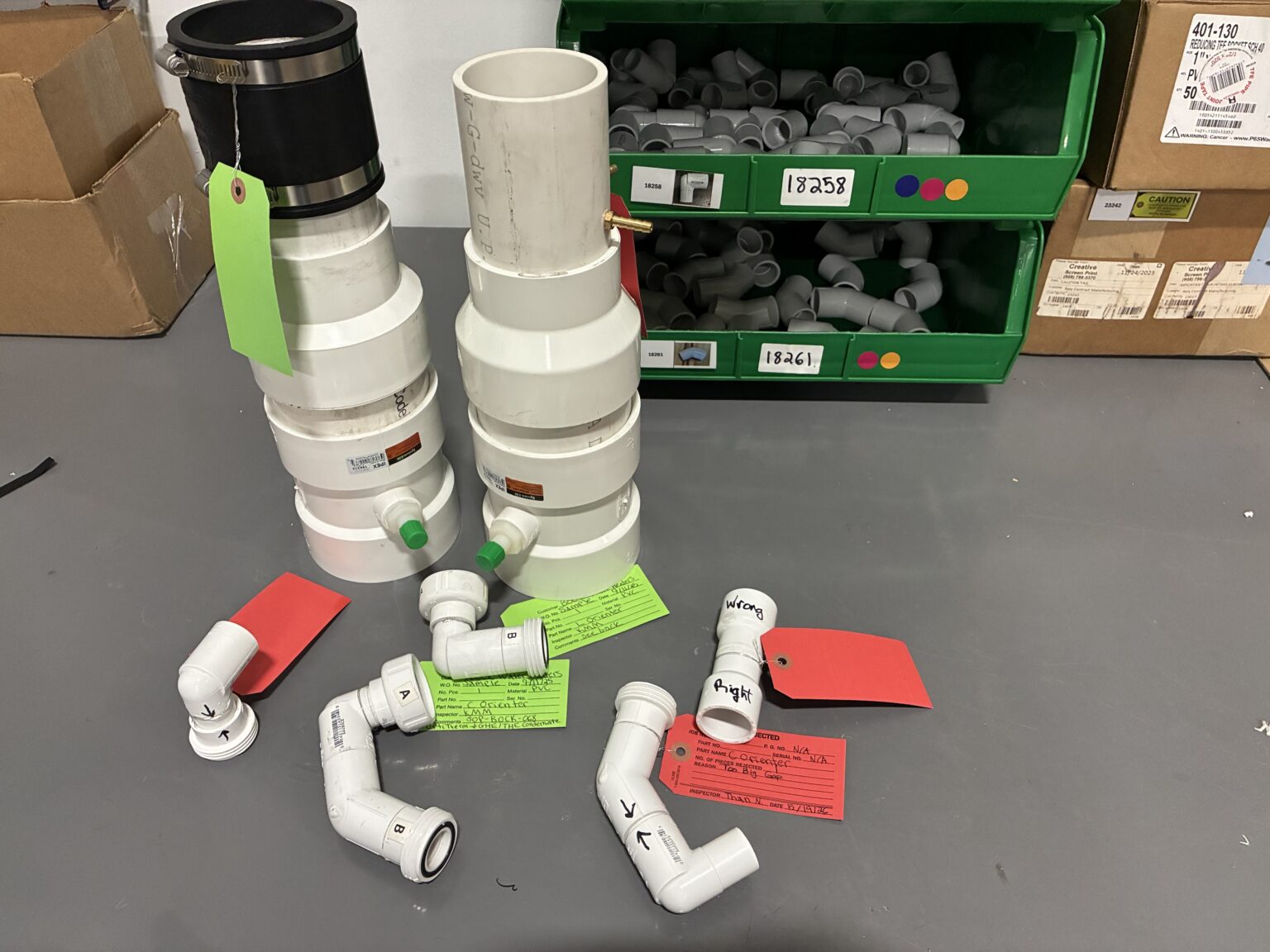
Turnkey assembly of intakes, exhausts, condensate traps, drain elbows and related subassemblies
Component procurement across 150+ component SKUs
Prototype, production and warranty subassemblies and kits
Phase 2: control panel assembly
Operating controls
Kits shipped ready to crate, with the customer’s QC checklist
Quality control of inherited raw-material suppliers, with 8Ds shared with the customer
Inventory visibility across 21 kit configurations
Outcome and period
2,400+ subassemblies and about 250 kits per month; a 2,000 sq ft subassembly area, including storage, shut down at the customer; 700 assembly hours saved in the first three months. After 90 days, process improvement and supply chain optimization brought pricing below the customer’s internal build cost, as reported in the case study.
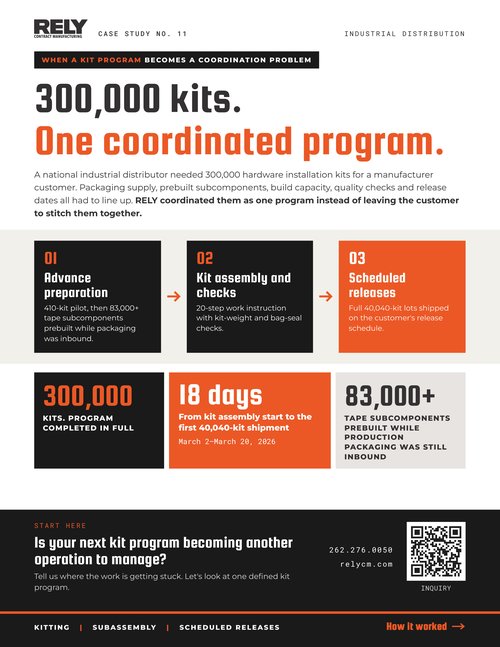
300,000 hardware kits ran as one coordinated program instead of a string of handoffs.
Packaging supply, prebuilt subcomponents, build capacity, quality checks and release dates all had to line up. RELY owned them together.
300,000
Kits, program completed in full
18 days
Kit assembly start to first 40,040-kit shipment
83,000+
Tape subcomponents prebuilt ahead of packaging
Read the summary
Buyer situation
A national industrial distributor needed 300,000 hardware installation kits for a manufacturer customer, with packaging, preparation, build and releases all depending on each other.
What RELY owned
Cartons, carton labels and pallets sourced; build planned around customer-supplied custom bags
410-kit pilot shipped December 8, 2025
83,000+ tape subcomponents prebuilt while production packaging was inbound
Staging and scheduled releases in 40,040-kit lots
Operating controls
A 20-step work instruction with kit-weight and bag-seal checks. Production and shipment quantities recorded in RELY’s ERP.
Metric notes
The 18 days run from kit assembly starting March 2 to the first 40,040-kit shipment on March 20, 2026. October 2025 to August 2026 is the overall program duration, not a production lead time.
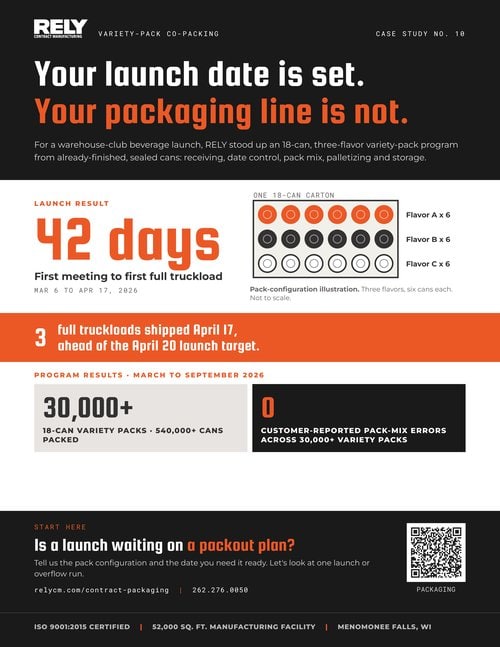
A new variety pack was due at a warehouse club. Three full truckloads shipped ahead of the launch target.
RELY stood up an 18-can, three-flavor variety-pack program from finished, sealed cans: receiving, date control, pack mix, palletizing, storage and releases.
42 days
First meeting to first full truckload
30,000+
18-can variety packs, Mar to Sep 2026
0
Customer-reported pack-mix errors
Read the summary
Buyer situation
A beverage brand had a warehouse-club launch date set and needed outside capacity to stand up a new variety pack quickly.
What RELY owned
Receiving and segregation by flavor and expiration date
Date-profile control across separate builds
Six cans of each flavor per carton, to the supplied dieline and pallet pattern
Two-shift ramp, storage and on-demand releases
Outcome and period
Three full truckloads shipped April 17, 2026, ahead of the April 20 launch target. 30,000+ variety packs and 540,000+ cans packed, March to September 2026, with zero customer-reported pack-mix errors.
Metric notes
The 42 days run from the first meeting on March 6 to the first full truckload on April 17, 2026. It is this program’s result, not a standard lead time. RELY did not fill, formulate or process the beverage.
Managed on-site production · Wisconsin injection molder
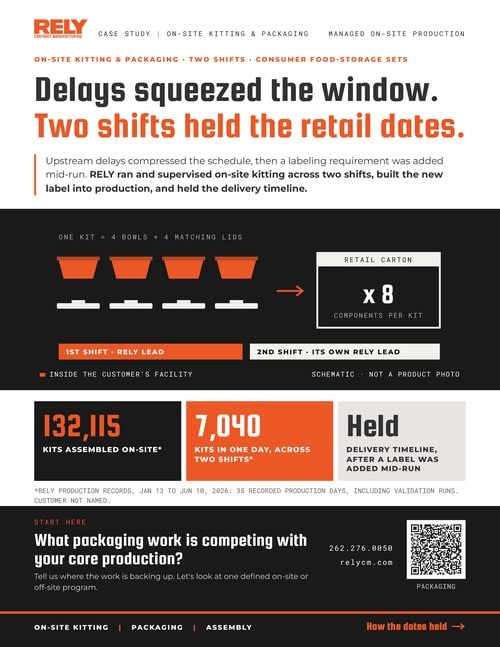
Delays squeezed the window. Two shifts inside the customer’s plant held the retail dates.
RELY ran and supervised food-storage kitting inside the customer’s facility, built a mid-run labeling requirement into production and held the delivery timeline.
132,115
Kits, Jan 13 to Jun 10, 2026
7,040
Kits in one day, across two shifts
31,518
Kits, highest recorded week
Read the summary
Buyer situation
A Wisconsin injection molder needed four-bowl, four-lid food-storage kits packed inside its own facility for a consumer brand’s retail program after upstream delays compressed the schedule.
What RELY owned
A RELY lead on each shift, with a RELY production manager supporting
Kit build and downstream packaging: 1,056,920 bowls and lids in all
Validation and restart after a labeling requirement was added mid-run
Line review and recommended fixes for equipment, materials and pallet handling
Operating controls
A 1,120-kit labeled validation run passed audit before full-rate restart, and the labeled process ran on both shifts.
Metric notes
35 recorded production days, including validation runs; recorded days are not consecutive calendar days. Peak figures describe this program, not a capacity commitment.
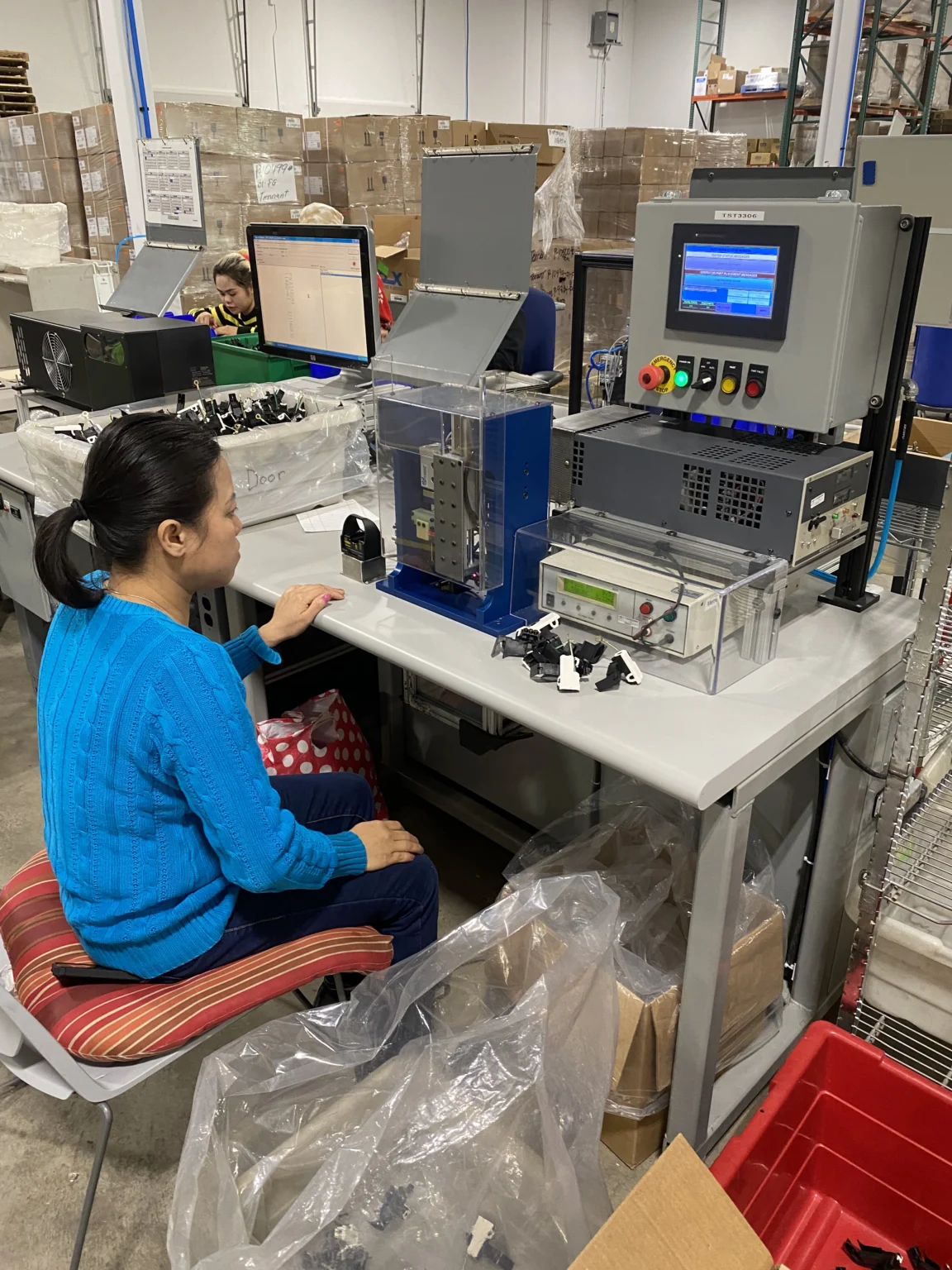
An incumbent exited three UL product lines. RELY took over the tooling and the responsibility.
The hard part was never running the equipment. It was requalifying another supplier’s tooling, suppliers and manufacturing history through full PPAP under RELY’s name.
3
Legacy product lines transferred
10
UL part numbers requalified and PPAP approved
85
Raw-material and component SKUs planned and stocked
Read the summary
Buyer situation
A major appliance OEM’s incumbent supplier exited three UL legacy product lines. The dies, anvils, testers and BOMs could move on a truck. The undocumented knowledge behind them could not.
What RELY owned
BOM complexity mapping, including 20 SKUs that need multi-supplier routing before reaching RELY
Full PPAP, start to finish
Supplier and BOM continuity
Tooling requalification and tooling resilience
Weekly production cadence
What the first order exposed
The specified resin was obsolete and the molder had none left. RELY worked directly with the resin manufacturer to identify two replacements meeting the full UL specification and purchased material to keep the program moving. Both materials became PPAP-approved primary and secondary options. When the inherited custom anvil failed on the first order, RELY brought in an outside machine shop after hours and shipped 400 finished parts the following Monday, then ordered three replacement anvils as the permanent correction.
Metric notes
Figures describe this program only. Customer approval authority stayed with the customer.
Mask assembly moved in from out of state and ran in under four weeks. Six more product lines followed.
RELY time-studied the work before the move, then had production running at RELY in under four weeks from go-ahead.
<4 wks
From go-ahead to production at RELY
104,609
Masks, Apr 2021 to May 2022
7
Product lines for the same customer
Read the summary
Buyer situation
A Wisconsin injection molder wanted mask assembly moved from out of state to sit closer to its molding operation, without a gap between the old line stopping and the new one starting.
What RELY owned
Pre-move time study so the labor requirement was known
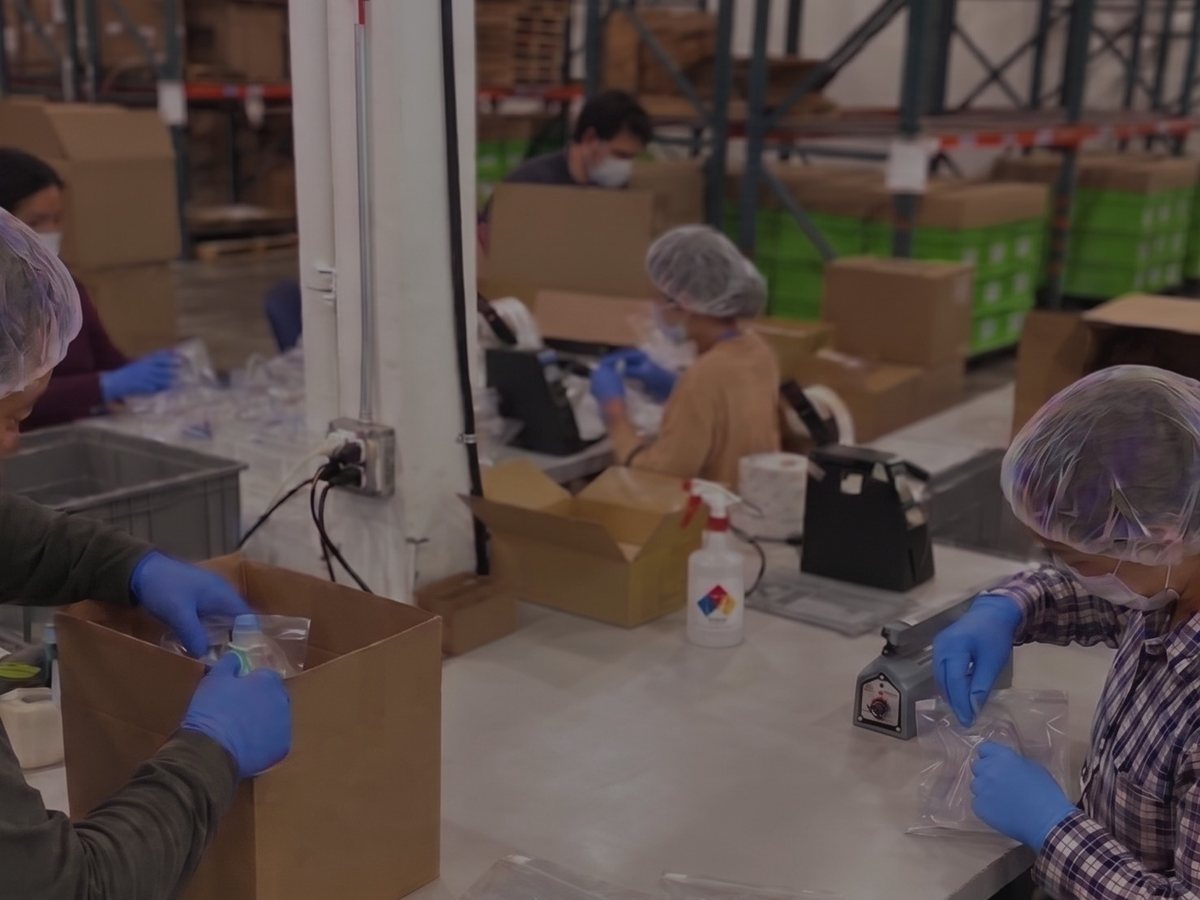
Assembly, cleaning and kitting under RELY’s GMP policies for that program
Three mask sizes under one controlled program
Individual bagging and packout
Outcome and period
104,609 masks assembled from 307,347 molded components, April 2021 to May 2022, peaking at 17,375 masks in September 2021. The customer moved six more product lines to RELY: 210,689 units across seven lines, April 2021 to August 2022.
Metric notes
The 210,689 total includes masks and the six additional lines; it is not a mask total. Historical program.
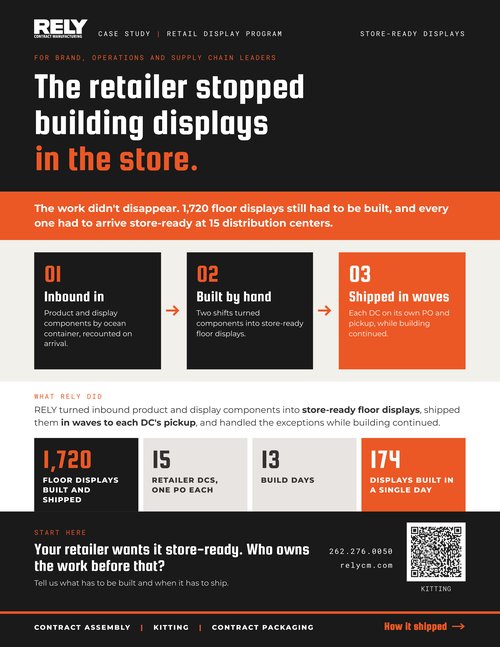
The retailer stopped building displays in the store. RELY built 1,720 and shipped every PO.
RELY turned inbound product and display components into store-ready floor displays and shipped them in waves to 15 retailer distribution centers.
1,720
Floor displays built and shipped
15
Retailer DCs, one PO each
13
Build days, Jul to Sep 2026 program
Read the summary
Buyer situation
A national tool brand’s retailer moved to pre-built floor displays for a fourth-quarter promotion, with one ship window per distribution center.
What RELY owned
Receiving and line-by-line recounts of ocean-container inbound
Two-shift display build to a released work instruction and quality alert
Staging and shipping waves: 15 POs, 7 carriers
Exceptions while building continued
Exceptions handled
A 600-piece shortage found at receiving, about 30 displays repaired on site, pallet supply backfilled from RELY stock and a split carrier load rebooked. All 15 POs shipped by September 4.
Metric notes
13 build days within the July to September 2026 program, not a 13-day calendar lead time. Highest recorded day: 174 displays. Shipment is reported, not delivery performance.
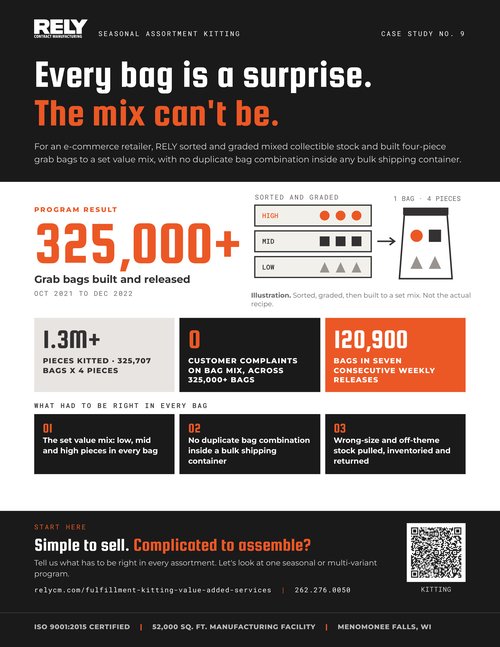
Every bag was a surprise. The mix wasn’t. 325,000+ bags, zero complaints on bag mix.
RELY sorted and graded mixed collectible stock and built four-piece bags to a set value mix, with no duplicate combination inside a bulk shipping container.
325,000+
Bags, Oct 2021 to Dec 2022
1.3M+
Pieces kitted
0
Customer complaints on bag mix
Read the summary
Buyer situation
An e-commerce retailer needed bulk, customer-supplied collectibles turned into themed grab bags with the right value mix in every bag through peak season.
What RELY owned
Sorting, grading and returning off-spec stock
A set count of low-, mid- and high-value pieces per bag
Up to four themed assortments per release
Releases matched to the season, including 120,900 bags across seven consecutive weekly releases
Outcome
Zero customer complaints on bag mix across 325,000+ bags. The same business later brought RELY a returns-grading project.
Metric notes
325,707 bags x 4 pieces = 1,302,828 pieces. Historical program, October 2021 to December 2022.
A beverage brand moved FBA fulfillment and variety-pack kitting to RELY.
In-house FBA fulfillment was pulling leadership and production resources into daily pick-and-pack work while growth consumed floor space the core process needed.
359%
FBA volume growth over 6 months
360,000
Units fulfilled via FBA in 2025
194
SKUs supported
Read the summary
What RELY was responsible for
FBA fulfillment execution: pick and pack, labeling and ship coordination
Controlled co-packing of variety packs and multipacks
Packout definitions, cartonization rules and work instructions before ramp
Operating controls
Lot and expiration-date verification during kitting
Marketplace packout, labeling and documentation requirements built into the work
Visual work instructions across shifts and volume swings
Outcome and period
The customer’s FBA volume grew 359% over six months while RELY ran fulfillment; 360,000 units were fulfilled via FBA in 2025, across 20+ packout formats and 5 to 7 ship-to locations per transfer order.
Metric notes
The growth figure measures the customer’s FBA volume, not sales. RELY supported the growth through fulfillment execution; demand was the customer’s.
Documented assembly · Medical diagnostics developer
Scientists were building every cartridge by hand. RELY turned the build into a process another team could run.
RELY documented the assembly in 18 visual steps with three inspection gates, joined the customer’s lab build in eight weeks and later assembled cartridges at RELY.
8 wks
First process walk to joint lab build
18
Documented assembly and inspection steps
300
Cartridges later assembled at RELY
Read the summary
Buyer situation
A medical diagnostics developer relied on its scientists to build cartridges in 1,000-unit lab lots while demand arrived faster than the lab could build.
What RELY owned
Observed the builds and recorded every station
18 visual assembly and inspection steps with correct and incorrect examples
Three critical-to-quality inspection gates
Tool and supply recommendations; controlled heat-seal packaging
Outcome and period
RELY operators joined a three-day joint build at the customer’s lab eight weeks after the first process walk: 1,100 cartridges total. In fall 2022, 300 cartridges were assembled at RELY.
Metric notes
The 1,100 cartridges are combined output from the joint build, not RELY-only production. Historical program, 2022.
A hard-to-staff switch line moved to RELY. Two more followed.
A washing machine hidden-lid switch assembly line had become difficult to staff, and inconsistent demand was creating backlog.
3
Switch assembly lines moved to RELY
3
New molding presses installed in the freed space
Read the summary
What RELY was responsible for
Operating the semi-automated line inside the customer’s facility first, then moving the equipment into RELY’s facility.
Operating controls
RELY created the work instructions, quality inspection instructions and preventive maintenance instructions for the line.
Outcome
The customer installed three new injection molding presses in the freed space. Two years later, two more appliance switch assembly lines moved into RELY’s facility, covering washing lid switches, hidden lid switches and snap rotary switches.
Source
Program example published on RELY’s Industries page (electronics and appliances).
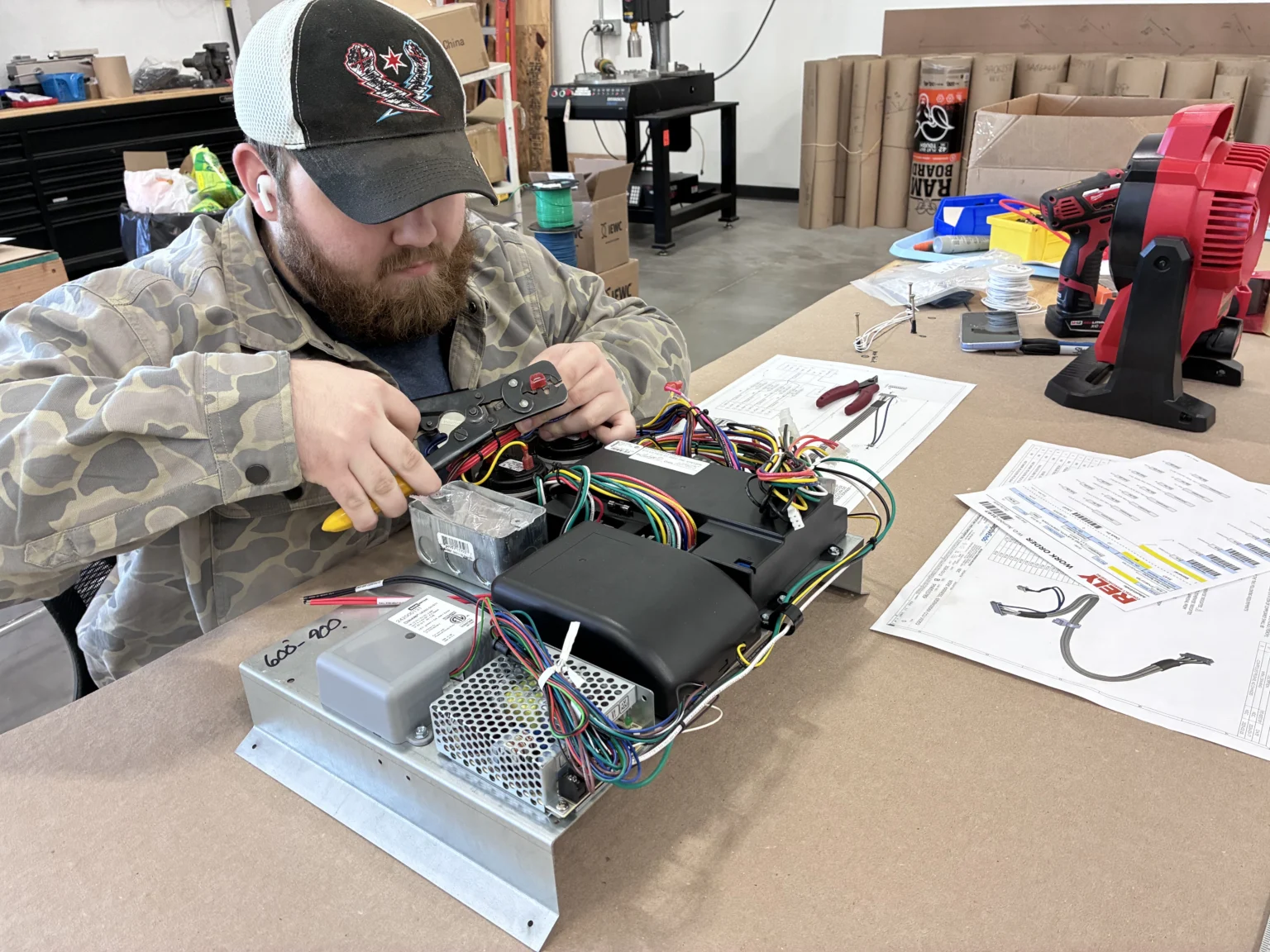
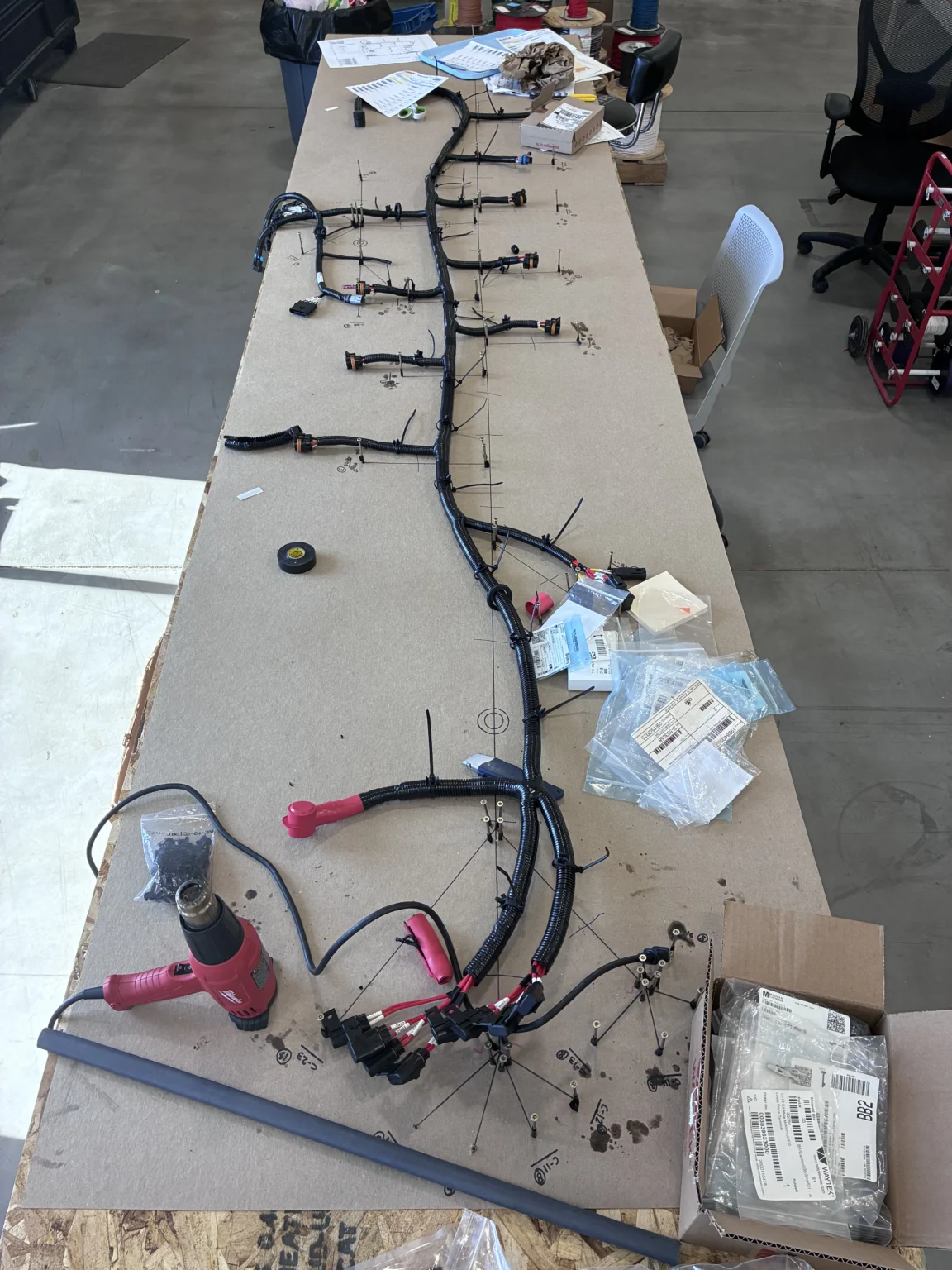
Engineering was building harnesses. RELY took them on.
Engineers were building prototype, engineering-build and service harnesses while chasing parts, tooling and print clarifications, and floor space and inventory were getting squeezed by growth.
174
Harnesses produced in 2025
28
SKUs in 2025
$20K
Stagnant inventory eliminated
Read the summary
What RELY was responsible for
Estimating, quoting and program management
JIT procurement with supplier coordination and min/max replenishment
Build, test and packaging, including in-house braiding and labeling
Operating controls
Managed catalog of 130+ connector SKUs with engineering change control
Print review during quoting to flag incompatibilities and print errors
100% continuity testing on every harness before shipment
Program scope
Volume ramped from 7 harnesses a week at launch to 25+ a week across multiple customers; orders of 1 to 45 harnesses; harnesses of up to 300 components and 90 circuits; 4 to 5 day quote turnaround for full procurement jobs.
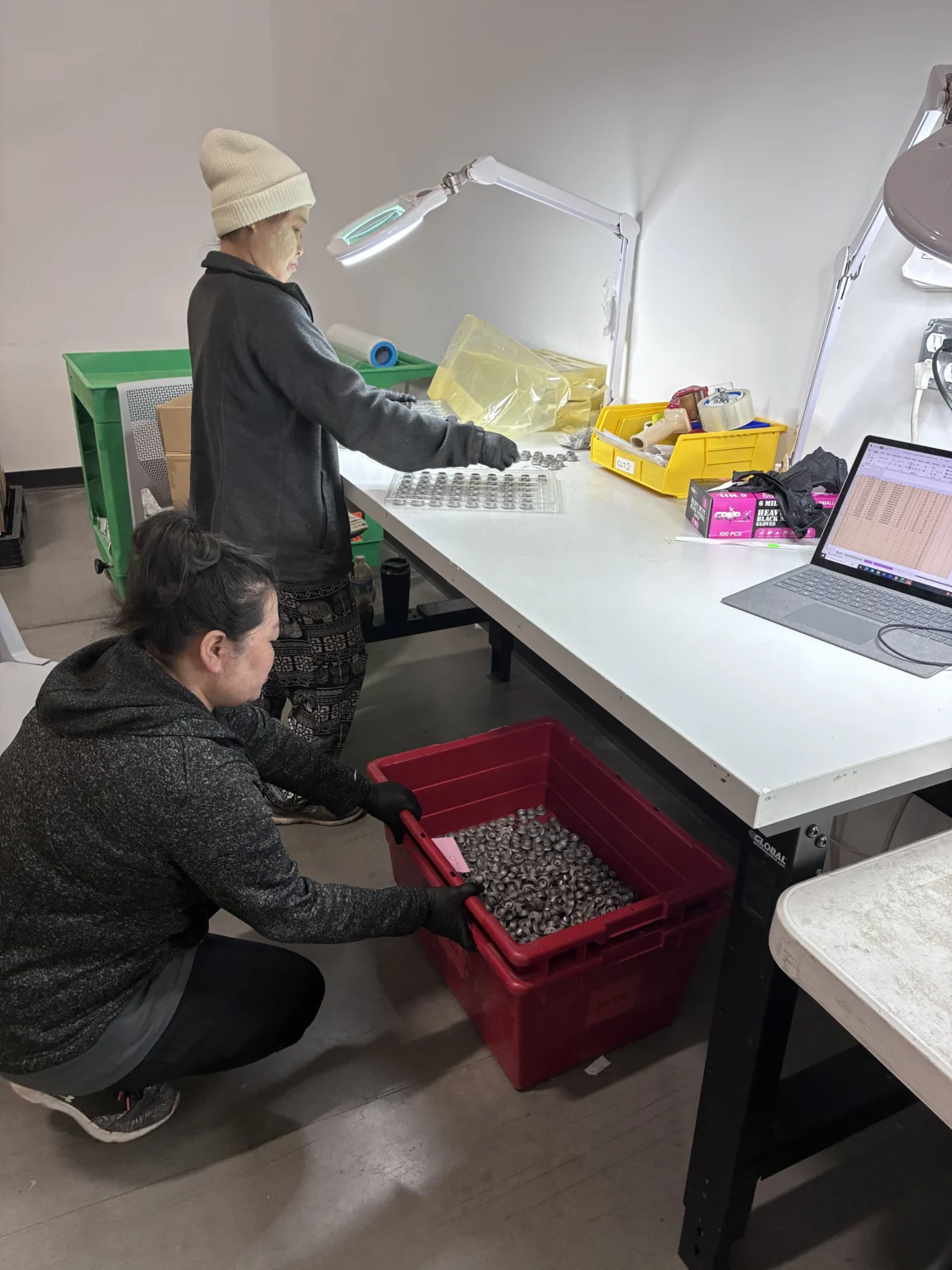
An inspection request turned into a supply chain rescue.
A global industrial OEM asked for inspection support on an offshore aluminum head casting. Early containment showed more than half of incoming parts failing specification across four failure modes.
2,500+
Parts inspected and reworked
100%
Inspection rate maintained
0
Line stoppages at the customer’s plant
Read the summary
What RELY was responsible for
100% incoming inspection of the machined features
Custom gauges designed and procured for bushing ID and press depth
Rework to print with custom-built machining tooling
Sourcing and managing three outside machine shops on the customer’s behalf
Operating controls
Standardized inspection criteria
Segregation of conforming, nonconforming and reworked material
Traceability through completion, with multiple passes as new defect modes emerged
Outcome
Critical features restored to specification and no line stoppage at the customer’s U.S. plant during the program.
In the customer’s words
“RELY didn’t just inspect parts, they stabilized our supply chain and kept our production line running.” Client quality engineer, as published in Case Study No. 18.
Sixteen suppliers. Sixteen chances to shut the line down.
Parts from 16 global suppliers were failing incoming inspection or tripping in-line equipment faults at two production facilities, with no dedicated resource to sort, hold and communicate.
4.4M+
Parts sorted in 2025
223
Shipments billed to the supplier
8,000+
Customer hours reclaimed in 2025
Read the summary
What RELY was responsible for
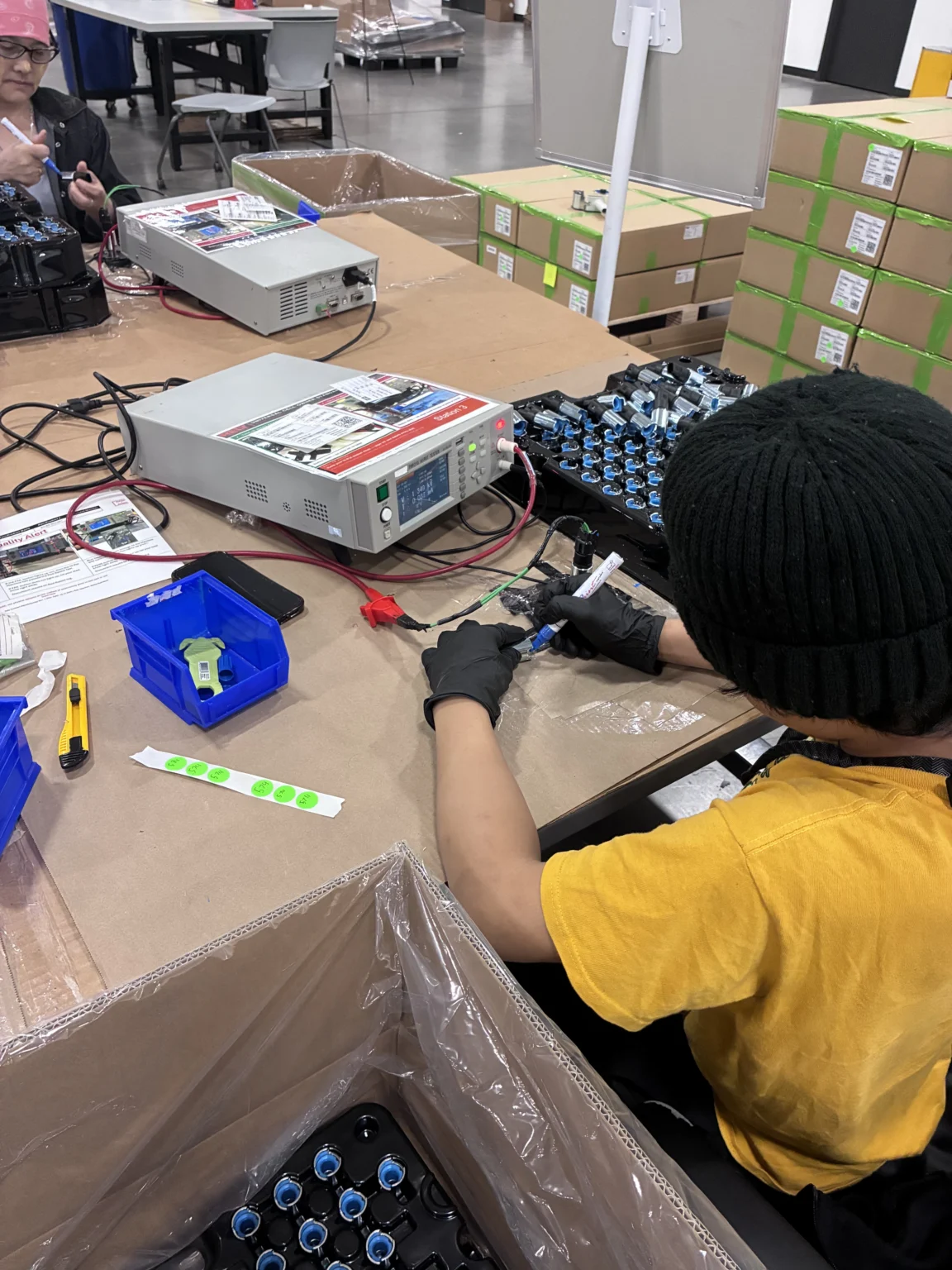
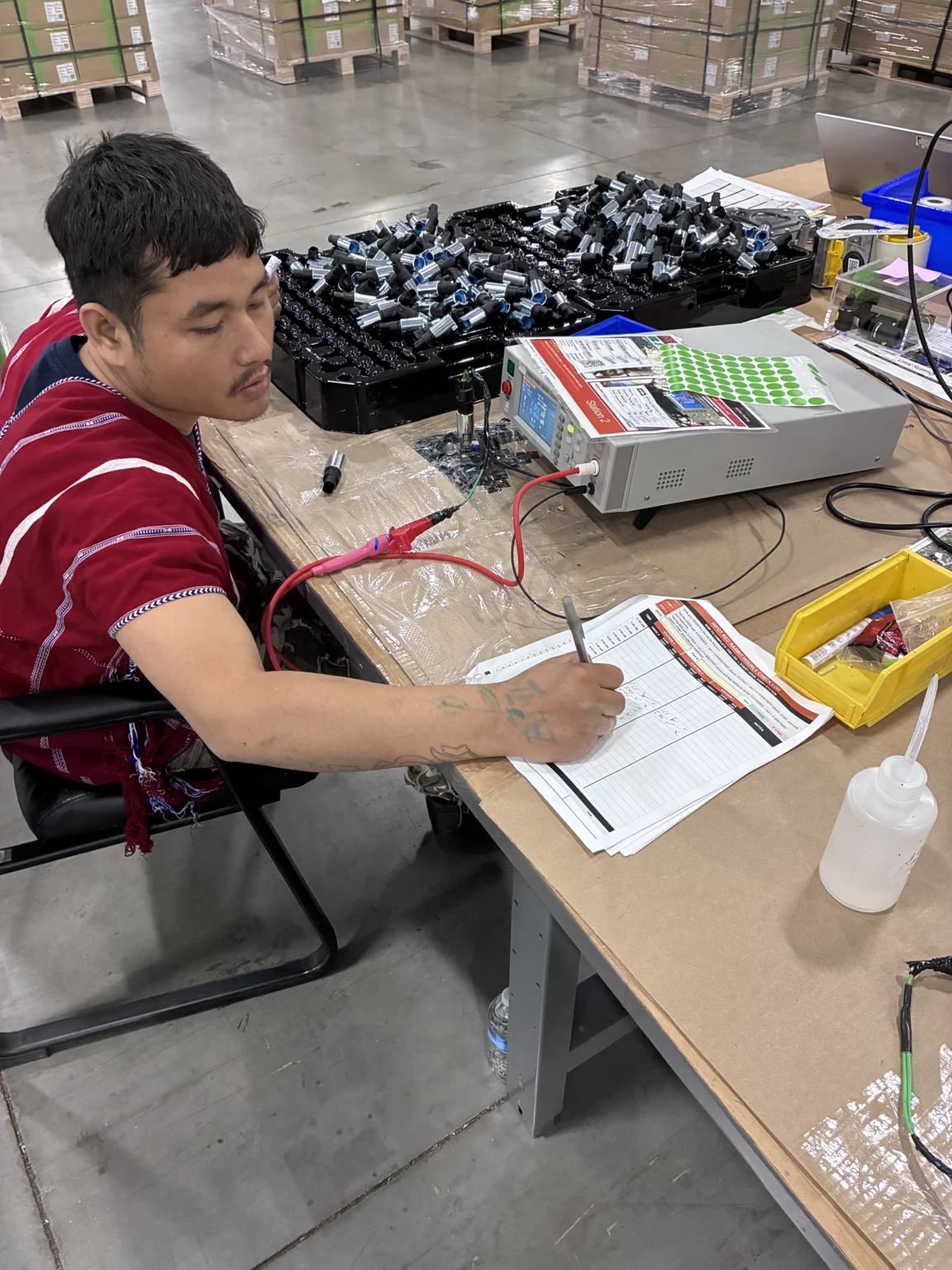
Supplier communication, RMA coordination and custody of nonconforming inventory once copied on a supplier NCR
Incoming inspection and sortation: visual, dimensional, electrical and functional
In-transit interception and multi-stage reclamation and rework
Transportation between RELY and the customer facilities
Operating controls
Daily and weekly reporting with lot-level traceability by failure mode
Good and bad samples with photos for supplier corrective action
Consolidated invoicing for coordinated secondary services
Outcome and period
In 2025: 4.4M+ parts sorted across 30 SKUs, 5 to 7 concurrent supplier sorts, 223 shipments billed to the responsible supplier and 8,000+ customer hours reclaimed. A two-week on-site proof of concept now runs 99% at RELY. Average response on a supplier NCR in this program: 4 hours.
Metric notes
The 4-hour figure is this program’s average NCR response, not a general deployment commitment. Customer hours reclaimed are as reported in the case study.
A year of reactive sorting was booked job by job. When the customer’s internal contact left, sorting stopped for two months and nobody could say what had been certified.
172M+
Parts inspected, Oct 2023 to Jul 30, 2026
4.1M
Defects caught and contained
1.25M
Parts in a single day
Read the summary
What RELY was responsible for
Running containment as a program: relaunched on real part numbers with the customer’s Director of Quality as sponsor, covering 34 catalog SKUs and up to 29 concurrently.
Operating controls
Revision-controlled work instructions for every part number
285 associates trained to criteria across 1,030 work orders
Shared channel with photo evidence captioned by failure mode
Controlled scrap tracker reporting fallout by named defect
Parts released off containment as they stabilize
Outcome and period
October 2023 to July 30, 2026: 172M+ parts inspected and 4.1M defects caught and contained. The end customer’s audit team reviewed the sorting floor.
Metric notes
Figures are cumulative for this one program as reported in the case study; they are not a capacity commitment.
Figures come from RELY’s published case studies and apply only to the program and period described.
Resources · The Quality Containment Series
One-page answers for the worst week of your year.
Each piece answers one question for one role, from the first hour of a containment to the audit afterward. Six pieces are available now; each opens as a web page with the PDF available to download, and a text summary follows the gallery.
1 / 6
Each flyer opens as a web page, with the PDF available to download.
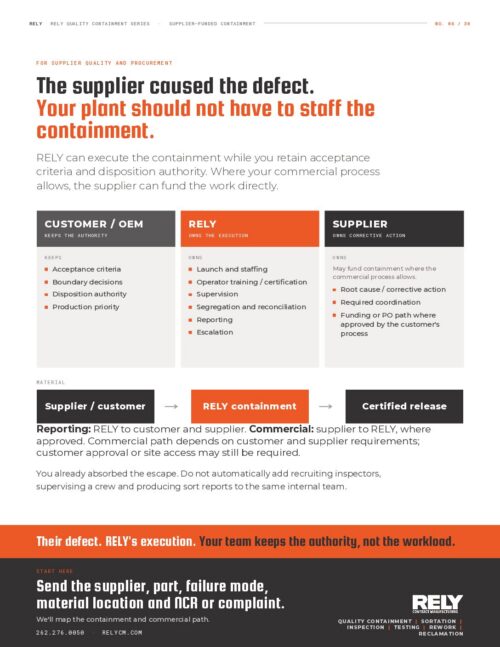
When a supplier caused the defect, RELY can run the containment while your team keeps the acceptance criteria, boundary decisions and disposition authority. Where your customer and commercial process allow, the responsible supplier can fund the work directly; customer approval or site access may still be required.
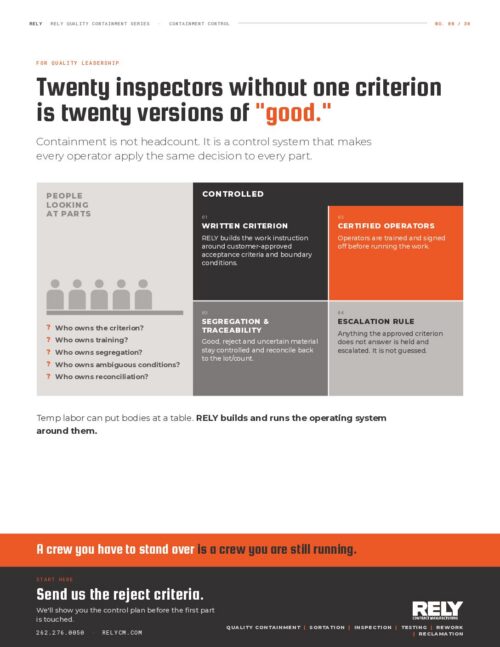
Containment is a control system, not headcount: a written criterion built around customer-approved boundary conditions, operators trained and signed off before running the work, good, reject and uncertain material reconciled back to the count, and anything the criterion does not answer held and escalated.
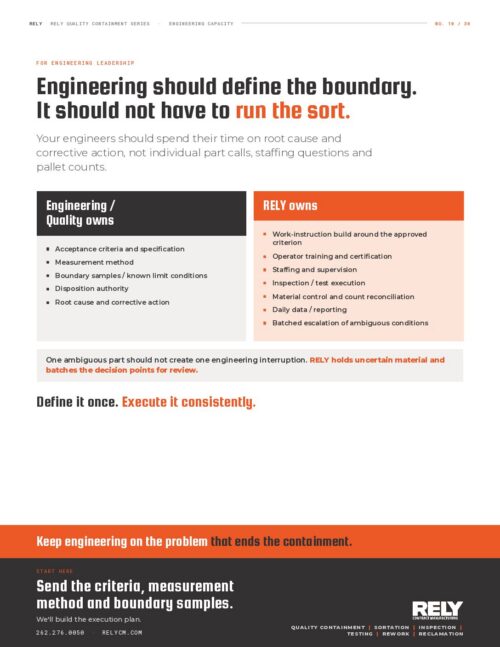
Engineering and quality own the acceptance criteria, measurement method, boundary samples, disposition authority and corrective action. RELY owns the work instruction, operator training, labor and supervision, inspection, material control, daily reporting and batched escalation of ambiguous parts.
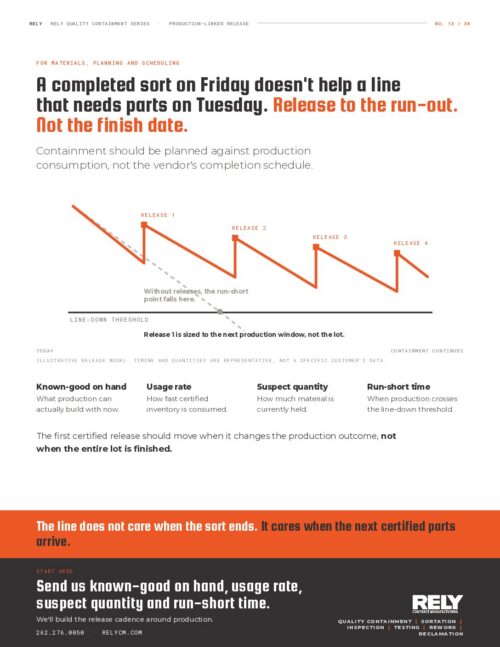
Plan containment releases against production consumption, not the sort’s finish date. The inputs are known-good on hand, usage rate, suspect quantity and run-short time; the first release is sized to the next production window. The flyer’s release model is illustrative.
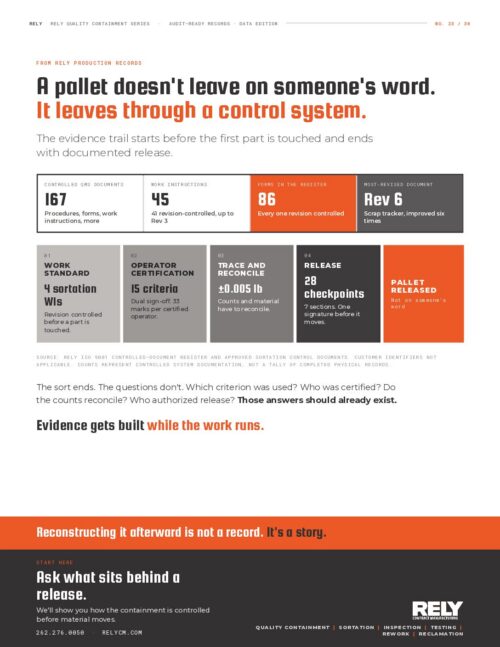
The evidence behind a release is built while the work runs: revision-controlled documents before a part is touched, dual sign-off on operator certification, counts and material that reconcile, and a signed release before material moves. Counts in the flyer describe RELY’s controlled document system.
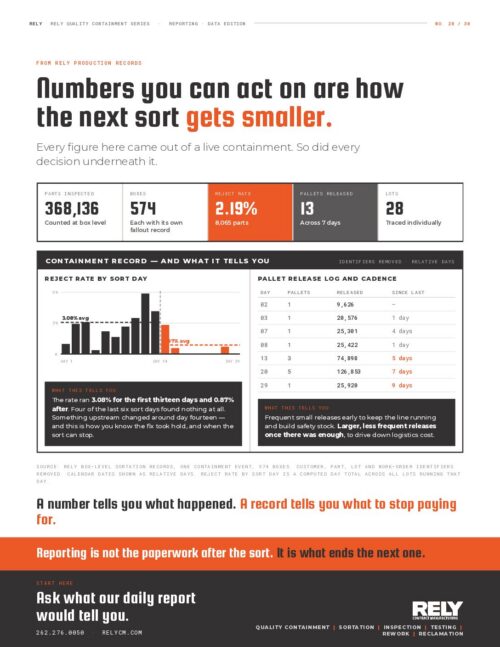
A real containment record with identifiers removed: 368,136 parts inspected across 574 boxes. The reject rate averaged 3.08% for the first thirteen days and 0.87% after, showing when an upstream fix took hold and when the sort could stop.
 No. 20